



Title: A Practical Guide to Power Analysis for t-Tests in R
Introduction:
Sound study planning starts with knowing whether your sample is large enough to spot an effect that matters. In R, a quick way to check this is through power routines built for the t family. This overview walks through the main ideas, common uses, and practical cautions when running such checks, so you can build studies that are neither under- nor overpowered.
Understanding Power for t-Tests in R
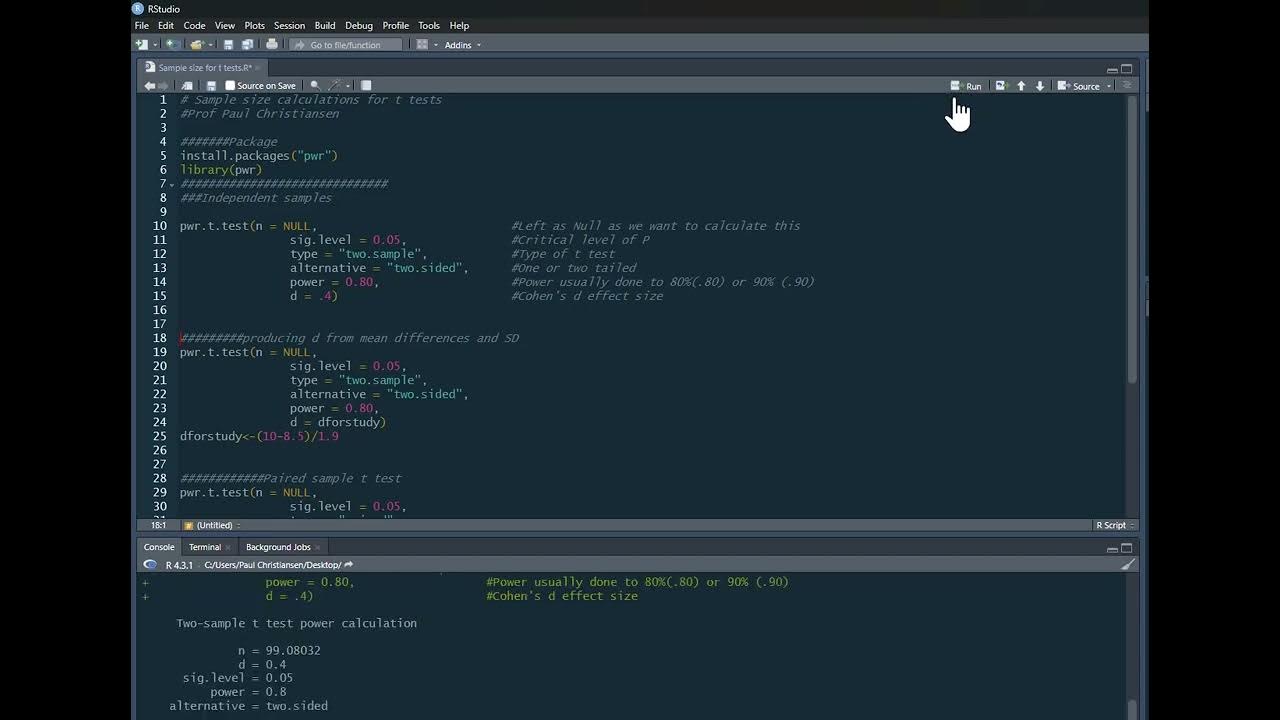
The pwr package offers a compact function that links five pieces of the puzzle: type of t-test, significance level, desired power, effect size, and sample size. Supply any four of these and the fifth is returned, letting you balance realistic resources against detectable differences.
Supported designs include one-sample, two-sample pooled-variance, and two-sample Welch variants. Arguments are short and intuitive—n for sample size, d for standardized effect, sig.level for α, and power for 1 – β—so you can iterate rapidly while drafting a protocol.
Everyday Uses
Most teams first use the routine to ballpark enrollment. By anchoring on a plausible effect gleaned from pilot data or the literature, you can learn how many participants are needed for, say, 80 % power at the 5 % level.
Once data are in, the same function can reveal how sensitive your test was. Enter the final n and observed d, and you will see whether a non-significant p-value could simply reflect low power rather than absence of an effect.
Finally, the tool helps calibrate expectations for follow-up work. Comparing the effect you saw with the smallest worthwhile difference keeps future trials focused on meaningful, not merely statistical, change.
Strengths
The syntax is beginner-friendly: one line of code plus plain-language arguments. Help files and worked examples lower the barrier for newcomers, while experienced users appreciate the speed of interactive “what-if” loops.
Flexibility is another plus. Switching among one-sample, parallel, or unequal-variance comparisons is as simple as changing the type argument, so the same block of code serves different study layouts.
Output is deterministic and transparent; no hidden simulation steps mean you can document exact assumptions for reviewers or regulators.
Cautions
All calculations rest on the usual t-test premises—normality and independence of errors. If skew or thick tails are likely, a simulation-based alternative may be safer.
Garbage-in-garbage-out applies to guestimates of effect size. Overly optimistic d can lull you into under-recruiting, while an overly conservative d inflates cost and burden. Triangulate with multiple sources whenever possible.
Illustrative Scenarios
1. A trial planner needs to compare two instructional methods. Setting d = 0.5, α = 0.05, and power = 0.8, the function returns about 64 participants per arm, shaping the recruitment budget.
2. A psychologist tests a mindfulness exercise. With 40 participants per group and an observed d = 0.35, post-hoc power is roughly 50 %, explaining why the p-value landed above 0.05 and prompting a larger replication.
3. A pharmacologist wonders whether a pilot drop of 3 mmHg in blood pressure is worth scaling up. Entering that observed difference as the target shows that hundreds of patients would be required for high power, guiding go/no-go decisions.
Conclusion
Building power checks into early planning guards against wasted effort and irreproducible findings. The pwr.t variant in R distills the conversation to a handful of numbers, making it easy to align sample size, effect magnitude, and statistical certainty in any two-group comparison.
As open-science norms push for preregistered protocols, transparent power statements are becoming standard. Mastering this simple function now will save headaches at review time and strengthen confidence in your conclusions.
Next steps include exploring simulation options for non-normal data, sharing templates that auto-update when assumptions change, and teaching the workflow in methods courses so more labs adopt rigorous sizing practices from the outset.


